
Meditation
The ground of presence
What it is
To meditate is to train attention to present experience, intentionally and without judgement. It is the practice of getting to know closely how your own mind works, and the foundation of a life lived with authenticity and belonging.
Almost everyone who comes here has tried before, with an app or a video, and stopped after two or three weeks. Rarely for lack of discipline. What is missing is knowing what you are training and what to do when practice does not go as expected, which is half the time, if not more.
The way we pay attention transforms experience, and what we pay attention to grows. This is the principle behind all contemplative practice. Knowing it intellectually changes little. When it becomes a gut-level knowing, we choose more deliberately what we give our attention to, because we know that is where change happens. We become freer and more present.

An ecology of contemplative practices
I use a map of three families of practice, proposed by Dahl, Lutz and Davidson (2015), because it clearly separates operations that everyday language blurs together.
- Attentional practices
- Regulating attention and meta-awareness. Through focused attention, on the breath or on sensory information, you train stability and clarity, as well as the ability to notice automatic reactions before acting on them.
- Constructive practices
- Perspective-taking and reappraisal. Deliberately cultivating compassion, loving-kindness (metta) and gratitude, reorienting perception.
- Deconstructive practices
- Self-inquiry into the nature of the mind, of thoughts and of experience. Developing an observing stance that does not identify with what arises.
The three train different capacities. Which one helps depends on what the person is looking for, and that is decided along the way.
Research and care
Research shows benefits of meditation for stress, anxiety and attention regulation. But a study captures little of what practice touches: the experience is subjective and reaches many dimensions. I use the evidence as support, and look to the contemplative traditions for inspiration to keep experimenting with and refining the practice.
There is also care to take. In intensive practice, or at certain times in life, meditation can bring up difficult experiences, and it is not always appropriate. We talk about this before starting.
When meditation is not appropriate · Questions about meditation
Where this practice appears
Meditation is part of Wing Chun, therapy and the workshops. If you are interested in meditation-only sessions, talk to me.
In Wing Chun, in the breath regulation and attention work that open and close each training session, and throughout technical practice, from Chi Sao to sparring, as Nim Lik: sustained intention and watchful attention to your own reactions.
In therapy, in the capacity to hold attention on difficult material without running from it, which is what makes trance work possible and what allows what emerged to be integrated afterwards.
In the workshops, in a format of their own, open to those not looking for individual work.
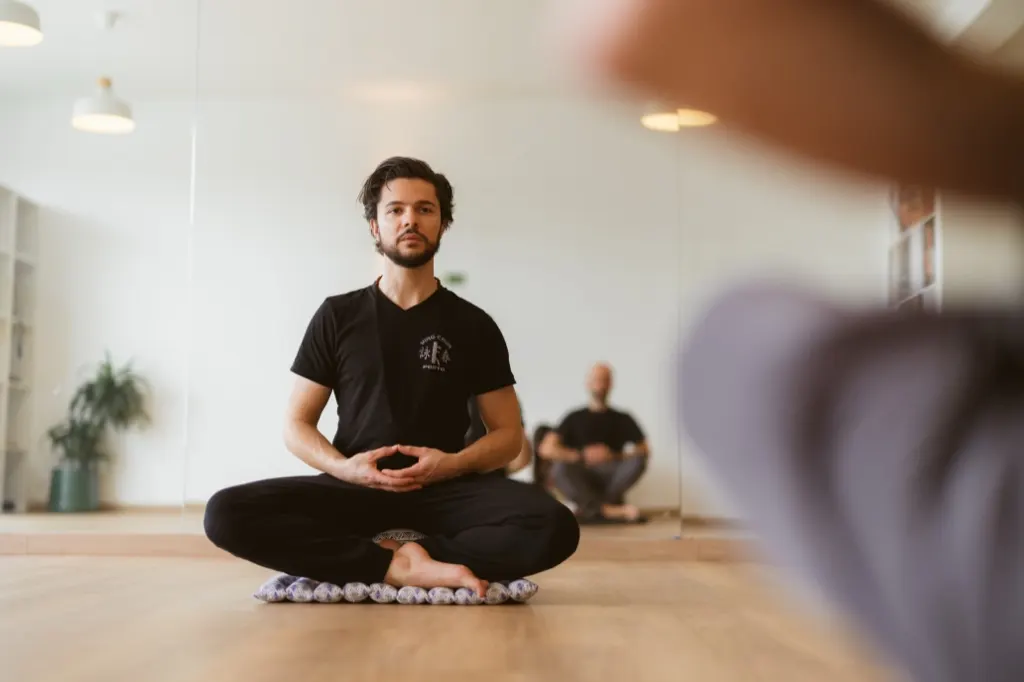
(Re)Introduction to Meditation workshop
Also in preparation is the workshop (Re)Introduction to Meditation, in four weekly two-hour sessions, online and in person. It is designed for those who want to start with structure and for those looking to practise in a group. It also suits people who already practise and want to give shape to a scattered practice. It uses practices from the three families above, in sessions that aim to reveal something to each person about themselves and their experience, and to give them momentum to follow their own path.
- Format
- Four weekly two-hour sessions
- Where
- Online or in person, in Vila Nova de Famalicão
- Price
- €45
- Dates
- TO BE DECIDED: dates of the first edition
Let me know if you would like to hear when the first edition opens.
Tell me about the next edition
Background
Continuous personal practice for more than 10 years, with regular retreats.
- Transpersonal Meditation Instructor, Escola Transpessoal (140 hours)
- Fundamental Course in Meditation and Mindfulness (70 hours), followed by the Instructor Training retreat (35 hours, AMARA certificate), Centro Budista do Porto